Of all the pests in this guide, termites inspire the most fear for the simplest reason: you almost never see them. A rat announces itself. A termite colony can spend years hollowing out a sill plate while the house above it looks perfectly fine. By the time a floor feels soft or a door starts sticking, the repair conversation has changed from pest control to carpentry.
That's the bad news. The good news is that termites leave evidence — consistent, readable evidence — and a homeowner who knows what to look for can catch them years earlier than one who doesn't.
The termite we have here
On Long Island, the problem species is the eastern subterranean termite. These insects live in the soil and eat wood, and they need both: the colony stays underground where moisture is reliable, and workers travel up into the house to feed. That commute is the vulnerability that gives them away.
Why East Hampton homes are exposed
Three local factors do most of the damage:
Age and construction
Many homes here are older wood-frame structures — some a century or more. Timber that has taken on a hundred years of coastal humidity is softer and easier to work than fresh lumber. Stone and brick foundations full of old mortar joints give termites hidden routes from soil to sill.
Moisture
Termites need it, and the coast supplies it. Damp crawl spaces, basements that smell musty by June, downspouts that dump roof water beside the foundation, and soil or mulch piled against siding all keep the wood near the ground wet enough to welcome a colony.
Wood-to-soil contact
Latticework touching the ground, deck posts set in soil, stacked firewood against the house, a garden bed built up over the foundation line — each one is a bridge from the colony to the structure.
The signs that matter
You don't need to see a termite to know you have them. Look for these instead:
Mud tubes
Pencil-width tunnels of dried mud running up foundation walls, piers or pipes. Subterranean termites build these to travel between soil and wood without drying out. A tube that crumbles when you break it and gets rebuilt within days is an active highway.
Swarmers and discarded wings
In spring, established colonies release winged reproductives — dark, ant-like insects with two pairs of equal-length wings. Finding a brief indoor swarm, or small piles of shed wings on windowsills and in spider webs, is one of the strongest signals there is. People constantly mistake swarmers for flying ants; the waist tells the story. Ants have a pinched waist and bent antennae; termites are straight-waisted with straight, beaded antennae.
Damaged wood
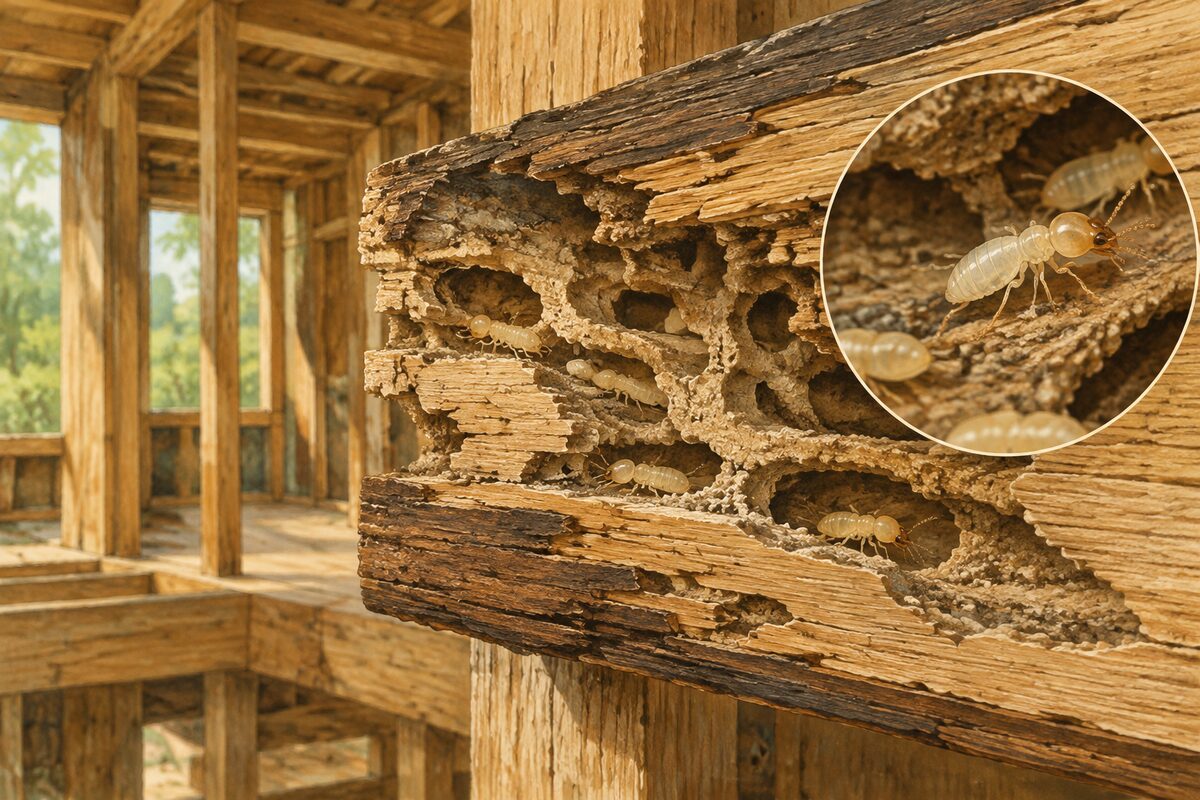
Tap a sill or baseboard with a screwdriver handle. Termite-eaten wood sounds hollow and may give way under light pressure. Broken open, it shows galleries running along the grain, often lined with a thin film of mud. Bubbled or rippled paint over trim can hide the same story underneath.
Nobody budgets for termites. The homeowners who fare best are simply the ones who look for them on purpose.
What a professional inspection covers
A proper termite inspection is slow and unglamorous: the foundation perimeter inside and out, the crawl space, the sill plates, the areas around plumbing penetrations, the garage, the deck connections, any addition with its own foundation line. The inspector is reading moisture, wood condition and construction details together — because termites follow damp, hidden routes, not convenience.
If activity is found, treatment typically means establishing a treated zone in the soil around and under the structure, or placing bait stations that the colony carries home. Either way, the point is the colony, not the workers you happen to see. This is decisively not a spray-the-baseboards job, and it's one of the clearest cases where DIY makes things worse: disturb a colony partially and it simply reroutes deeper into the structure.
If you've found tubes, wings or suspicious wood, it's worth reading about termite control in East Hampton, NY and booking an inspection before anything else. An inspection that finds nothing is the best money you'll ever spend on the subject.
Prevention you can actually do
- Keep soil and mulch several inches below siding and sill lines
- Extend downspouts so roof water discharges away from the foundation
- Fix leaks promptly — a sweating pipe in a crawl space is an invitation
- Store firewood away from the house and elevated
- Remove dead stumps and buried scrap lumber from the yard
- Ventilate the crawl space; consider a vapor barrier if it's persistently damp
- Look at your foundation twice a year — spring and fall — with a flashlight
The bottom line
Termites punish inattention, not bad luck. The colony working under a house right now will be discovered eventually — by a homeowner with a flashlight, or by a contractor with an invoice. Choosing the first option is entirely within your control, and it starts with one slow walk around the foundation.
Common questions
How fast do termites damage a house?
A mature colony consumes wood slowly but continuously — on the order of months and years, not days. The risk isn't overnight collapse; it's that quiet damage compounds for years before anyone looks. That's what makes periodic inspection so valuable.
Are flying ants the same as termite swarmers?
No, and telling them apart is easy up close. Ants have a narrow, pinched waist, bent antennae and two pairs of unequal wings. Termites have a straight waist, straight bead-like antennae and two pairs of equal-length wings. Either one indoors deserves a closer look.
Can I treat termites myself?
Surface sprays kill the workers they touch and scatter the rest — the colony continues untouched. Effective treatment means reaching the colony in the soil, which takes professional materials, equipment and, more than anything, experience reading the building.
Does homeowners insurance cover termite damage?
Standard policies almost never do — insurers treat termite damage as preventable maintenance. That's one more argument for catching activity early, while the repair is still small.
Found tubes, wings or hollow wood?
Book a termite inspection before the damage grows. Local technicians know exactly where older East Hampton homes hide their weak points.
Termite inspection & treatment in East Hampton